An Earthquake Rattles Boston
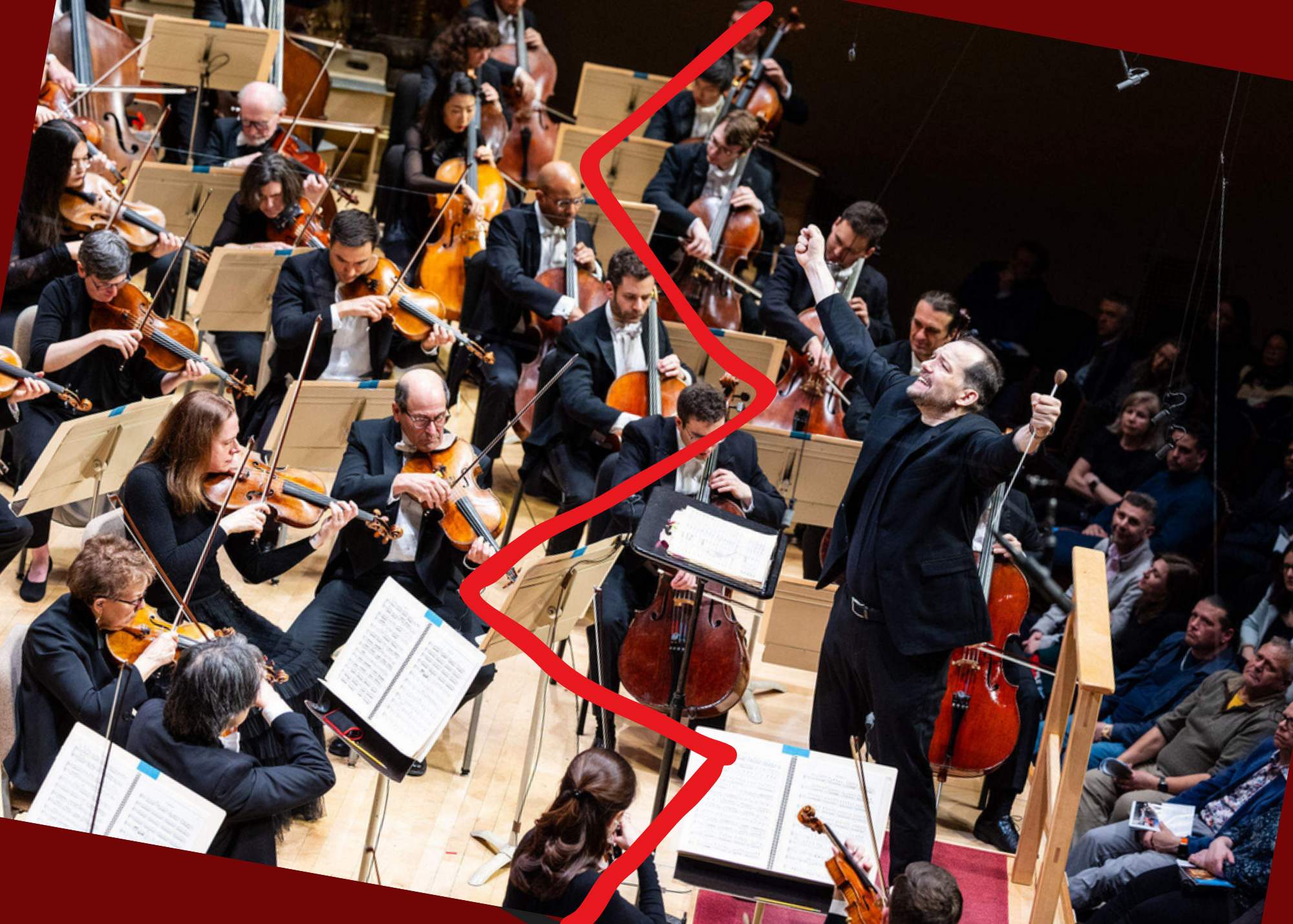
"This is not the standard one expects from the Boston Symphony." ––Bernard Haitink, 2001
On Friday, March 6, the musicians and retired members of the Boston Symphony received this email:
Dear BSO Players and Retirees:
We're writing to share an important update with you that Andris Nelsons will conclude his tenure as Music Director of the BSO at the end of the 2027 Tanglewood season. The decision to not renew his contract was made by the BSO's Board of Trustees because, beyond our shared desire to ensure our orchestra continues to perform at the highest levels, the BSO and Andris Nelsons were not aligned on future vision.
We are immensely grateful for Maestro Nelsons' 13 years of dedicated service to the BSO, and his many contributions in his role as both Music Director, and as Head of Conducting at the Tanglewood Music Center. We look forward to properly celebrating and honoring his tenure throughout the 2026-2027 season.
As we work to chart a course for our future that puts our beloved orchestra in a position to thrive in the years ahead, we and Maestro Nelsons are committed to ensuring a smooth, professional conclusion to his tenure as Music Director so that we can continue our vital work together of making music at the highest level of excellence, and serving as an artistic and civic pillar in Boston, the Berkshires, and beyond.
The Trustees of the Boston Symphony Orchestra
Chad Smith, President and Chief Executive Officer
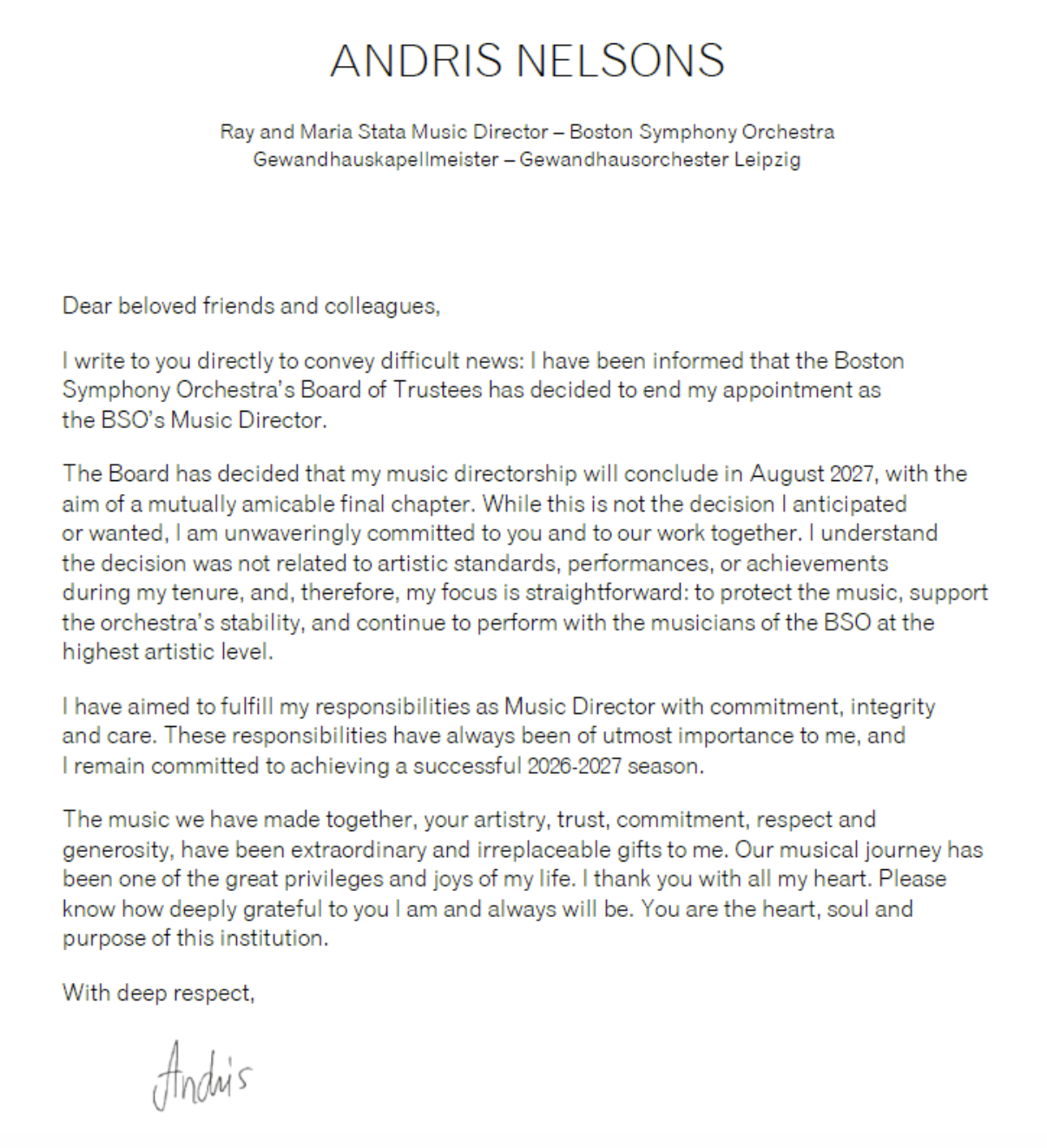
This announcement was as abrupt as it was unprecedented, and has sent shock waves throughout the classical music world. It was accompanied by this letter from Maestro Nelsons:
Perhaps it is telling that, in regard to the statement from Smith and the Trustees, that "the BSO and Andris Nelsons were not aligned on future vision," one can now find this on the Boston Symphony website:
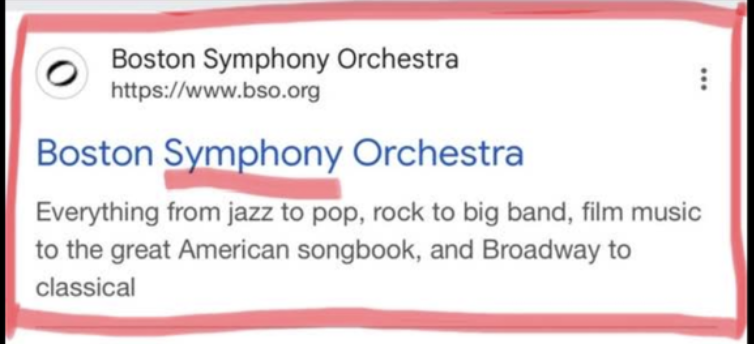
If that is the official Boston Symphony vision, placing classical music almost as an afterthought, the divergence of opinion between the Trustees and Nelsons becomes understandable. However, I suspect that not only the musicians are horrified by this new vision, but also audiences. As much as any orchestra in the world, the Boston Symphony has earned an undisputed reputation for the highest level of excellence, and for its core mission to be thusly downgraded must be unpalatable to all of its stakeholders.
The Boston Symphony musicians, who had neither been consulted nor forewarned of Nelsons' dismissal (Nelsons himself was out of town), convened an emergency meeting and issued the following statement:
We, the musicians of the Boston Symphony Orchestra, support our beloved Music Director Andris Nelsons.
We strongly oppose the decision by the Board of Trustees to end the appointment of Maestro Nelsons.
The musicians believe in Andris's vision for the future.
I would note that it is not unusual for orchestras musicians to express admiration, respect, and occasionally fear of their music directors. But to publicly used the word "beloved" for a music director, especially after 13 years, during which the honeymoon between musicians and their conductor almost always fades, speaks volumes. As does the following:
A concert tradition of American orchestras, which audiences expect, is for the musicians to arrive onstage one at a time for up to 20 minutes or so before a concert in order to warm up. On Saturday night, in a powerful demonstration of unity, the BSO musicians waited until a few moments before the beginning of the concert (conducted by guest conductor Herbert Blomstedt) to walk onstage together.
This year, the BSO musicians and management will be negotiating a new collective bargaining agreement. Such negotiations are intense, and to one degree or another, adversarial. (As a former chair of the BSO Players Committee, I can attest to this firsthand.) However, at the end of the day, both sides recognize that the process is not personal. The dismissal of Nelsons, however, and the manner in which it was announced, may have strained relations to a breaking point and does not bode well for a positive outcome.
In 2001, the BSO was on a European concert tour, conducted by the great Bernard Haitink. Typically, rehearsals on tour are mainly an effort to get the orchestra used to the acoustics of new concert halls, which are all different. Also, the musicians, trying to save their chops, sometimes do not give full effort. But that wasn't Haitink's approach to rehearsals. At one point, during the rehearsal of a movement from Smetana's epic tone poem, Ma Vlast, Haitink stopped the orchestra and said in a very soft voice, "This is not the standard one expects of the Boston Symphony." Nothing more needed to be said. That moment that came to mind when considering Nelsons's dismissal and the manner in which the BSO musicians were notified. "This is not the standard one expects of the Boston Symphony."
The question remains: Audiences love Andris Nelsons. Recording companies love him. International concert presenters love him. Orchestras around the world love him. The musicians love him. So, why?



Discussion
Leave a comment