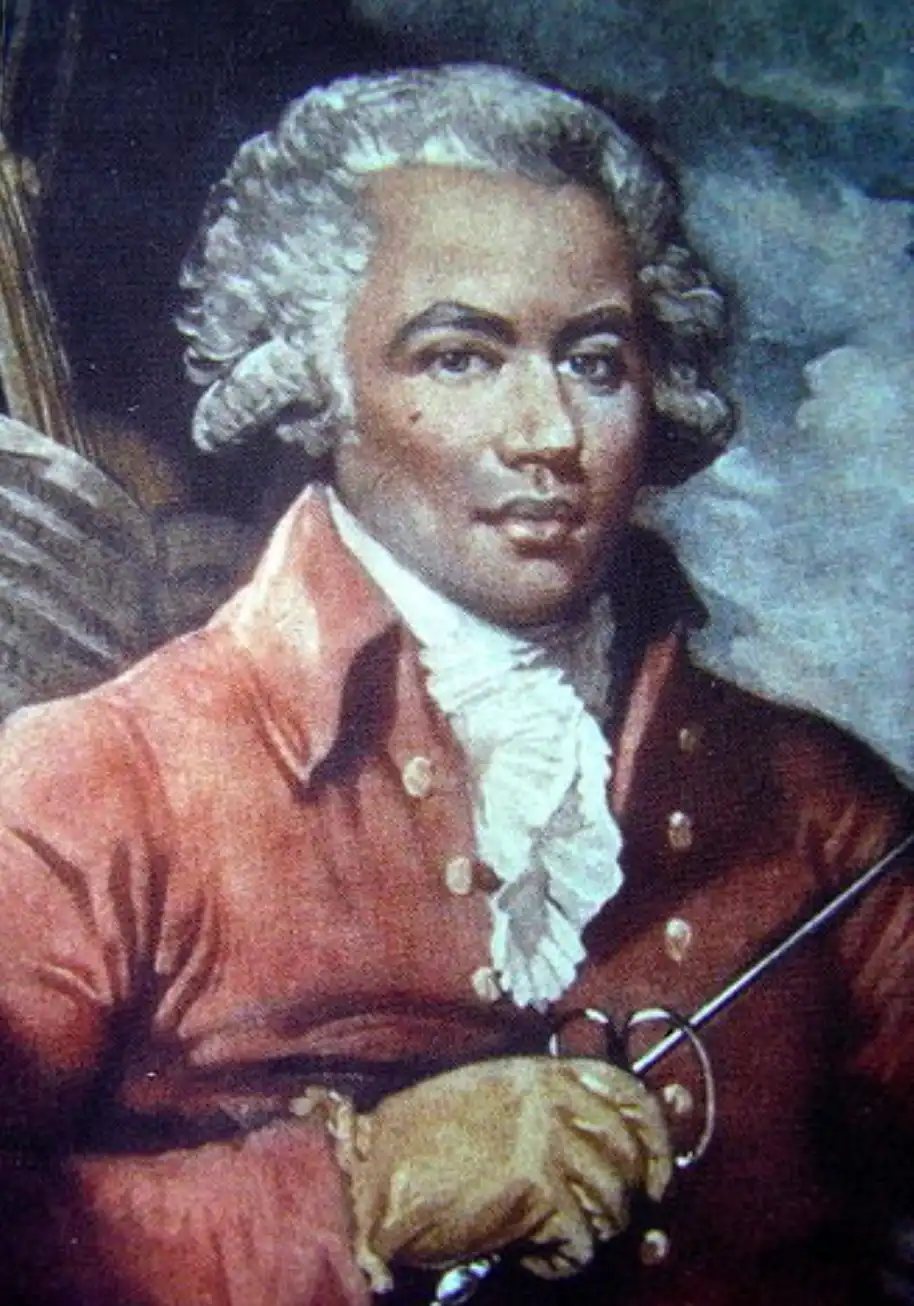
The Black Mozart
In an effort to regain some equilibrium in the aftermath of our 2016 national election, I returned to a juicy project I had been working on, preparation for a concert I conducted with Sinfonia Salt Lake in May, 2017.
Originally, the program was supposed to include the music of three generations of the Mozart family: Leopold, the father; Wolfgang, of course; and Franz Xaver, the surprisingly gifted and underappreciated son whose music is hardly known but should be performed frequently. I'd love to conduct that program sometime in the future!
For logistical reasons we had to change the program, including transferring from a piano soloist to a soprano, but I still wanted to do something equally innovative and with Mozart. Serendipitously (if that's a word), at about that time, one of my Tanglewood colleagues mentioned that there was a contemporary of Mozart whose name he couldn't remember, but was referred to as "the Black Mozart," and was well-known in his day. Sounded intriguing!
After some sleuthing, I not only found out who this composer was, I found some very fine recordings of his music, which is excellent. And a lot more:
Joseph Bologne, Chevalier de Saint-Georges (December 25, 1745 – June 10, 1799) was a champion fencer, virtuoso violinist, and conductor of the leading symphony orchestra in Paris. Born in Guadeloupe, he was the son of George Bologne de Saint-Georges, a wealthy planter, and Nanon, his African slave. During the French Revolution, Saint-Georges was colonel of the Légion St.-Georges, the first all-black regiment in Europe, fighting on the side of the Republic. Today the Chevalier de Saint-Georges is best remembered as the first classical composer of African ancestry. (Wikipedia)
In the old days, it would have taken a great deal more research to actually obtain the sheet music. However, in the new day and age, I found some of his scores online in a mere trice. Not only high-quality violin concertos and symphonies, but also the score to his finest comic opera, L'amant Anonime. The opera has an excellent overture, instrumental numbers, and soprano arias that suited the needs of the Sinfonia Salt Lake program to a T. The only problem was that the score was in a scrawled handwritten manuscript (whose, I don't know, and there are a million mistakes), and there were no orchestral parts.
So, my project was to make the music concert ready, transcribing the music into legible form. Though it was extremely tedious and time-consuming, it's a project that I savored, not only because I'd discovered some beautiful music totally new to me, but also because as I worked on it, I gained a deeper appreciation for the miraculous contributions made to our culture and history by people of color who have surmounted impossibly formidable obstacles.
I highly recommend you read more about Saint-Georges and listen to his music which, since 2017 has become highly popular, and as you do so, to reflect upon what has made the culture of our own country so uniquely rich, and what we need to do to as a people in 2026 to continue to foster that.
Let me know if you'd like the score and legible parts that I've written! I'm happy to share!



Discussion
Leave a comment